

It’s not unusual for me to talk about AI and the impact of AI in the world. But this time I want to talk about something most people are actually ignoring in the workplace.
It’s what I call THE BIG SQUEEZE.
And it’s not a fear mongering article but a strategic analysis.
This is not about AI replacing humans, especially in white collar jobs. It’s about the fact that this has been happening for the past two years in silence. And the way this is being rolled out is so elegant. So silent.
So that most people are unaware of it.
If you look around, if you ask friends, family, your sons or daughters, siblings or regular working people around you, you will notice two big trends.
Numero Uno: The Bottom squeeze
The young, graduates just getting out of school/uni into the workforce, are having a hard time getting a job. Entry level jobs are getting harder and harder to get.
And this is becoming more evident in some countries more than others. The EU for example, countries like the UK, Spain, France, Italy are being affected the most. So in certain economic areas, if you zoom in, e.g London, and especially in certain careers, this becomes more evident by the minute.
In the US it’s probably “slightly” a different story, because the affluence of work (and work generation) and the volume of the workforce is way bigger.
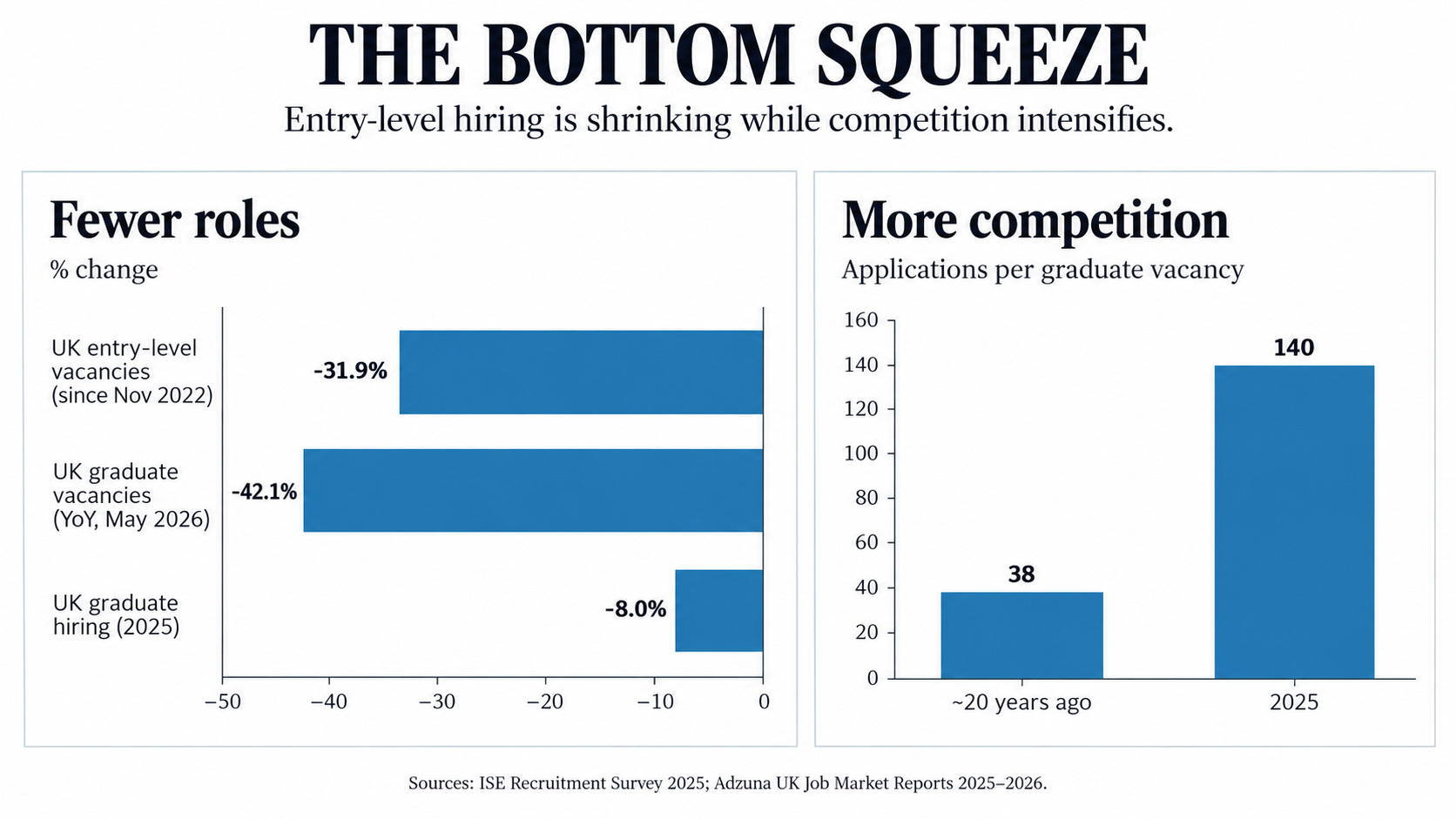
This is accelerating. And not stopping.
Yes, some people get “the job”, and yes, the market has openings. But if you are in those careers where the repetitive tasks you were doing at entry level are something current LLMs can do, then your job is being compacted. And most companies are not even catching up with the trend.
What I mean by compacted is this:
Before, you might have a law firm opening 10 roles for a summer internship, or 10 roles for low entry jobs. Today you have less than half in average. And it’s not because they don’t have the workload. It’s because agents are going into the workforce.
Latham and Watkins, one of the biggest firms, the other day confirmed they’re buying servers to run their own proprietary LLMs. We saw the same race in legal with Legora.
Most of the jobs that were landing after school/uni are now basically gone or trending down rapidly. Commercial, creative, entry level in marketing, people, talent, operations, are going first.
All those roles are probably one eighth of what they were two years ago.
And yes, some people might be getting jobs, some due to qualifications, some to other random reasons. But the majority of young people will have a hard time getting a job. Don’t take my word, ask around.
And if they do get one, it’s so competitive that the salaries are extremely low.
If you think about it, you will hear that a lot of companies right now are telling you, “oh, let’s optimize this with AI, and the best get’s a bonus” or “Let’s do agentic workflows”. All companies are agentic now.
They offer bonus. They offer promotions. They offer optimization. They’re hyped about it. They offer courses.

Aren’t you digging your own grave?
And this is another key element in the “Squeeze theory”. If you’re at your job, you will see this coming up in every meeting. Agentic workflows. Agentic implementation. Agent, agent, agent.
This is the reality. We are shifting towards a world where most of the repetitive jobs, and those that don’t require expertise, are done by agents.
And those that require expertise, that’s expertise acquired in the past. Because it will be very hard for young people at entry level to acquire that expertise. There will be no way for them to acquire it, because that work will be done by agents.
And this is the squeeze from the bottom.
Numero Dos: Top Down squeeze
And then, if you turn around, depending on the age group of your family, start asking more qualified people. I’m talking director level, management, upper management, executive, C level. If you start talking to people with years of experience, you will notice a different trend.
The people that were going into organizations, you see less mobility now. You hear of VPs, directors, C levels having a hard time getting into a new role.
And this is not only because of AI. It’s a byproduct of AI.
And I’m going to explain why.
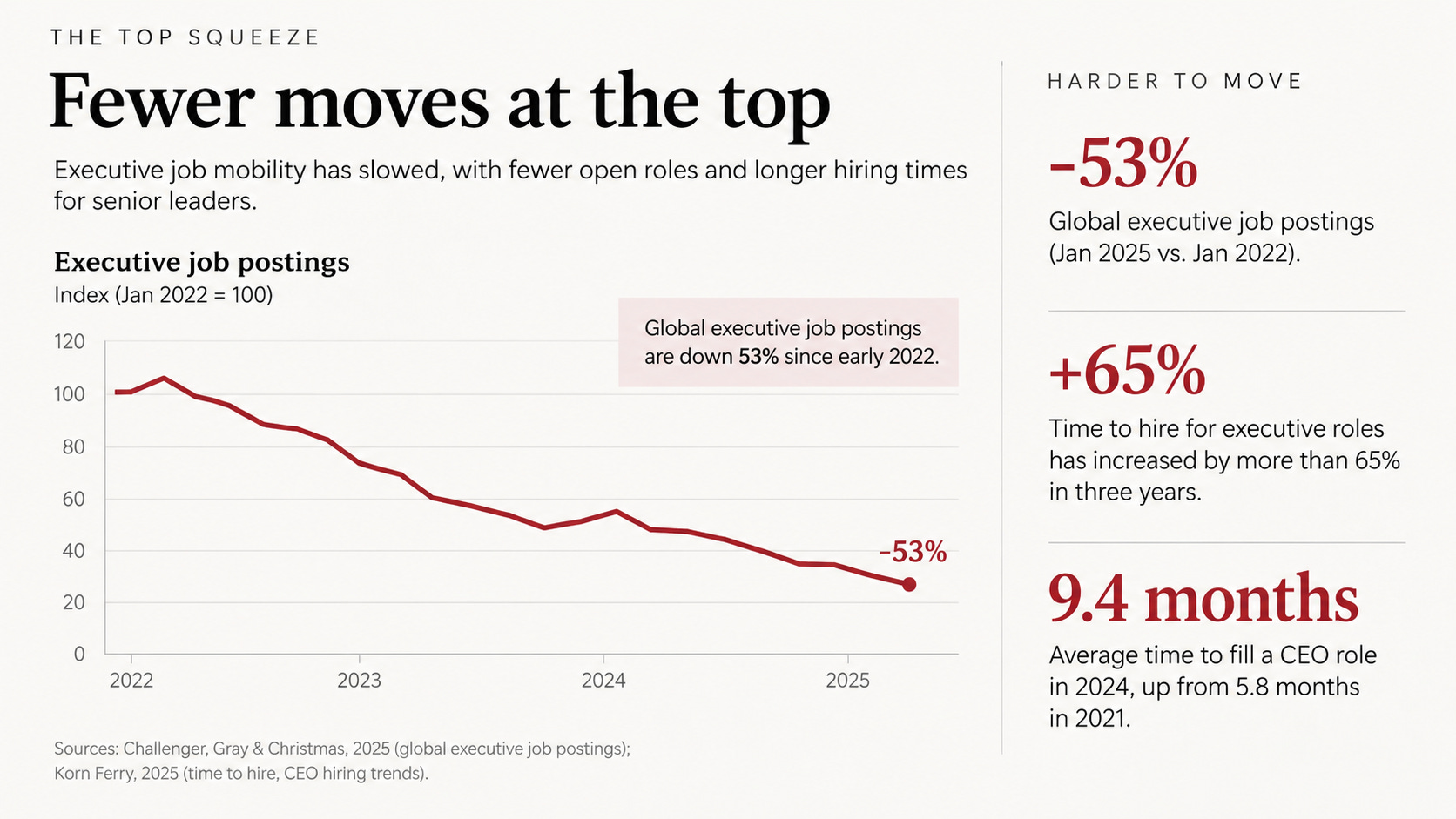
AI and decision making performance at C level today is very difficult to obtain, but not impossible.
I’ve talked to many founders that say, hey, I can create my CFO agent. And I always say the same. Yeah, sure, you can. But you will not have a human to decide if what the CFO agent is proposing makes sense in the real world or is hallucinating. And if you want to play that bet, that is a problem.
First let’s divide higher roles into categories of companies.
More mature companies that require more mature career people, like banks, big corporations or 2000s tech giants. Those are the least affected. Because they’re very slow.
The other day I posted on LinkedIn a video of a guy talking about how he added a timeline change to Google Places, where they had a scroll bar, and it took nine months to ship. Because of everything Google had to do to verify those nine or ten lines of code wouldn’t affect anything.
So bigger companies are extremely slow. And it will be very slow for them to implement any major agentic workflow, especially if they’re not in tech. So they would hire, they would go to another “transformation.”
But there is another big part of the industry “The Startup”.
The new companies rising up, because we live in the age of technology where companies that didn’t exist five or six years ago exist today. And what is going on right now, again from my perspective , is that it’s very hard for experienced people to get jobs as fast, to switch as fast as before.
And this is in part because of AI. But what AI is doing is making those “Heads of’s”, those C levels, way more effective at their job. So they either stay longer if they are comfortable, or you get the byproduct we’re seeing if they leave, which is “fractional work”.
For example, I can choose to either work for a company nine to six, or I can work for six different startups, a few hours a week, 30 hours a week.
Before, jumping into a startup, I’d have to do a full review of the financials, the situation, the structure, history, systems, etc. That would take me couple of days to compile. Talking to all the people another bunch.
Now I can have conversations with systems, and database ( also people), feed those conversations into an agentic workflow, analyze all the data from five, six, seven years back, all the financial data in my case, all the KPIs company wide, in a day.
So after a week I have enough structured information to start reviewing, start digging, start going into processes.
That was not possible before. That would require more time invested, a few delegations, waiting and waiting, and waiting a bit more.
Today all done from our desks with a team of agents.

So those clients are getting premium quality C-level operator level work for a few hours. Before they had to pay a premium, +$350,000 a year.
Is the market is shifting? The first stage of everything sometimes is denial. Or was acceptance?
This trend is not only affecting finance. WE see this in marketing, in tech. We see fractional CPOs, we see fractional CTOs, we see the rise of fractional people that can actually manage agents and leverage the experience acquired in the industry.
And if you are in that frontier, with most companies shifting into an agentic mindset, then you are at the top of the top of the top.
The market has shifted folks. The squeeze is happening on both ends.
The young are getting excluded from opportunities. The top are not necessarily full time anymore.
What’s Left: Middle squeeze
And that’s another thing that’s going to happen. The more agents we include, the less management we have. Less people we have, less people we need to manage other people.
Catch my drift? So then the middle will be squeezed too.
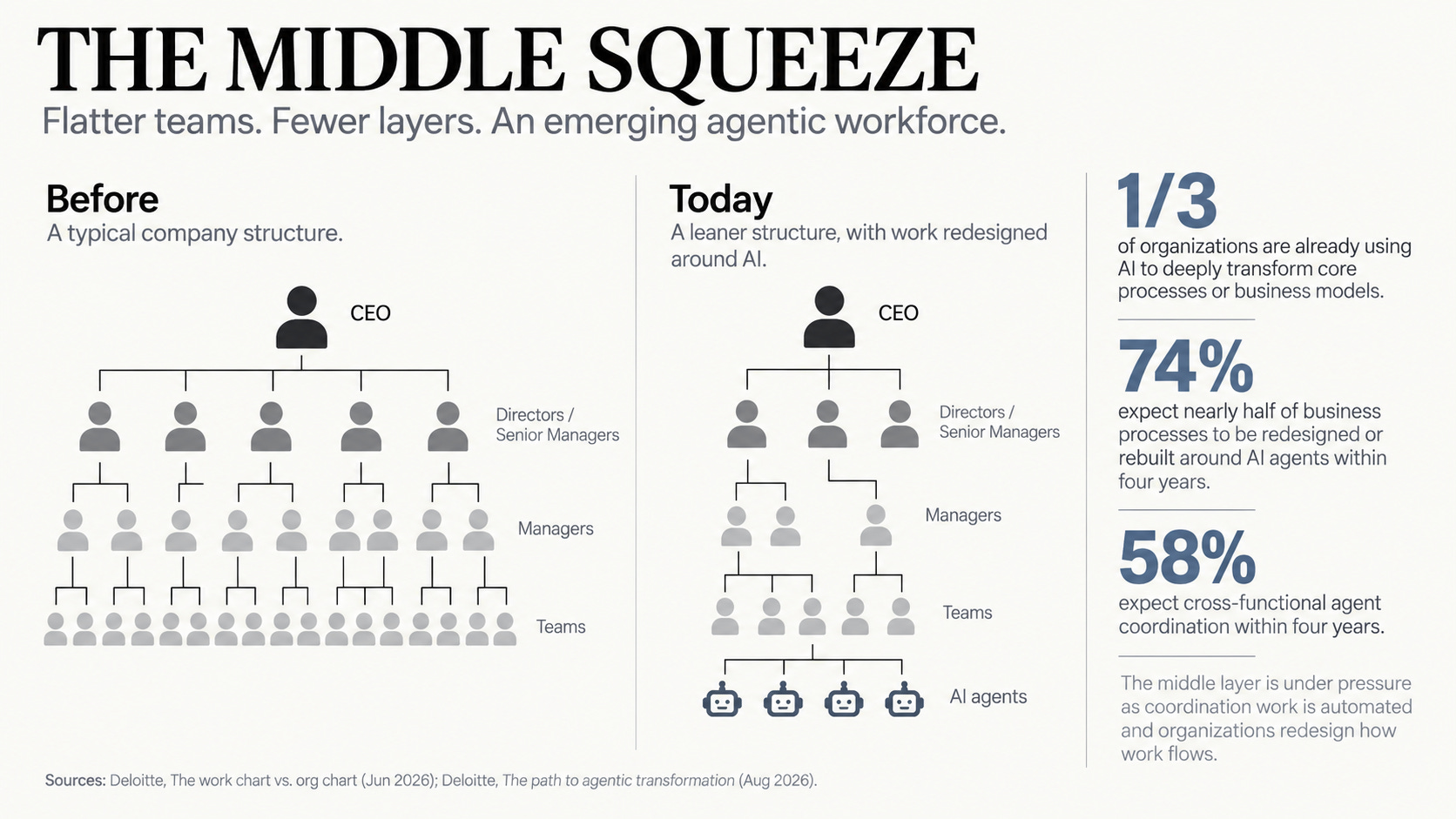
Like I said this isn’t a theory anymore, look around, ask around. My point with all this is that there is a transformation happening.
Of course agents cannot do today what teams do with high effectiveness, because the technology is not there yet. But if you look behind at the advancements of the past two years and what the models are capable of now, there is a trend.
And it would be very unwise to ignore it.
And I’m not talking about coding agents. Tech people, I don’t want to piss you off. But if you’re in tech, you have to recognize that it came freaking good. We talk about AI slop. But I’ve seen crappy code from humans. Human slop is also real.
The rest of us, we have to be honest as well. Legal work, technical work, operational work, marketing work, copy creation, will be at some point turned into a workflow. If there’s and SOP a process an agent can do it.
Jobs are not being replaced by Ai, tasks are.
Replaced from the bottom. And it’s being pushed from the top. There will be a point where management will be less necessary. The middle will be thinner.
The alternative is here. Know those agentic workflows. Be aware in the company you’re in. Be predictive. Create yours.
With every new technology there is a great opportunity.
So if you’re reading this, and if I can help in any way, and if you ever had the chance to start something on your own, whatever it is, I highly recommend you do it.
And I would highly recommend doing things that are in real life rather than tech. The future will be entertainment, or experiences.